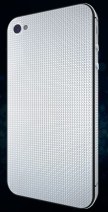
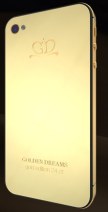
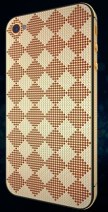
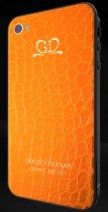
Switzerland-based brand Golden Dreams just unveiled a special luxury edition of Apple's iPhone 4S.
The device is an iPhone 4S 64GB and it comes with a choice of five different high-class finishes - two Desert editions with alligator leather, Gold edition in either 24K or 18K gold, and Diamond edition that can carry up to 4 thousand pristine rocks on its back.
Golden Dreams iPhone collection
Now as for the most important factor - pricing - the Desert edition starts at CHF1990 (approximately $2176), while the Gold edition costs CHF2290 (or around $2504). As for the Diamond version - that one has a "price upon request" monicker.
You may already know that a certain Ms. Fu Chunli from China was the person who ended up downloading the 25 billionth app from the App Store. As usual, Apple caller her up and offered to fly her to Beijing where she will be presented her prize, the $10,000 iTunes gift card, interact with the media and get some training for her iPhone.
Turns out, Ms. Chunli bought her new iPhone just a month before downloading the lucky 25 billionth app. She was unaware of this competition by Apple and was understandably confused when she got a call from Apple, concluding that it was just some hoax. It was later when she got the email from Apple that she finally believed that she had won the prize.
After that, Chunli was flown to Beijing by Apple, where she visited Apple's corporate headquarters and the Sanlitun retail store, where the award ceremony was arranged.
After all that, we are guessing that the iPhone won't be the last Apple product that Ms. Chunli would be purchasing. As far as the iTunes downloads are concerned, she seems to be sorted for life, what with $10,000 sitting in her account.
Oh, and just in case you were wondering which was the 25 billionth app, it was Disney's game Where's My Water?.
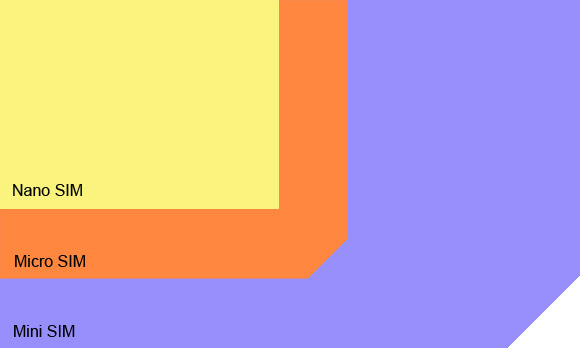
A few days ago, we reported that Apple is locking horns with other companies, primarily Nokia, regarding the design of the nano-SIM, the next generation of the SIM design that will be dramatically smaller than even the current micro-SIM. Both companies have put forth their version of what nano-SIM design should be, with each claiming theirs to be better.
Image courtesy Esato
Apple's design so far was the most popular among the European carriers, and there is a good chance that it is the one that gets chosen eventually. This led to some fears that Apple will eventually control the license and others will have to pay royalty to use it.
Now, however, thanks to a recent discovery by Florian Mueller of FOSS Patents, it has come to light that Apple will offer the license to its nano-SIM patent royalty free. This means that tomorrow if the design gets chosen, then other companies won't have to pay Apple anything to use their patents regarding the nano-SIM design on their devices.
This proves that at least Apple is in this just to establish a new SIM standard that is smaller (and therefore better) rather than trying to make money off it.
iOS users have historically been shown to quickly upgrade to the latest update compared to other platforms and with the latest release of iOS 5.1 this seems truer than ever.
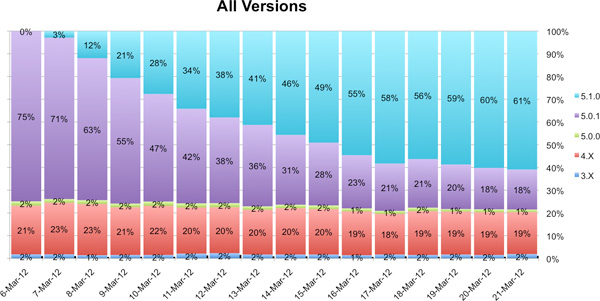
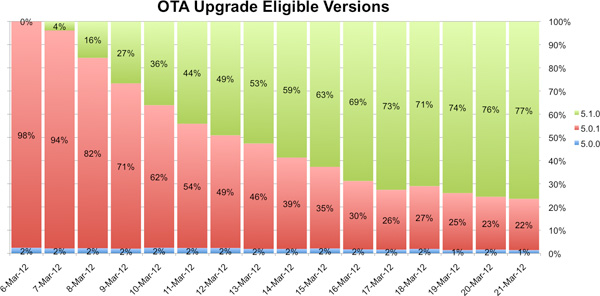
Developer David Smith who created the app Audiobooks, a universal app available on both the iPhone and the iPad in free and paid variants and with around 100,000 weekly downloads, has some statistics that he collected from the users downloading his app every since Apple released iOS 5.1 on March 7.
As you can see from the graph above, fourteen days after iOS 5.1 was released, 61 percent of the total users downloading his app were using it, with only 18 percent on the older iOS 5.0.0. The 19 percent of the users on iOS 4.x are likely those using older versions of the iPhone or iPod touch, who are not eligible for iOS 5.
If we look at only iOS 5.x users, the number is even more impressive, with 77 percent of the users on the latest update.
One of the suspected reasons for the quicker adoption of the latest iOS updates is the addition of over-the-air (OTA) updates that was introduced with iOS 5. Now since the update is available directly on their devices, users are more likely to instantly update their phones as soon as it is made available, instead of doing it some time later by connecting it to their computers.
Of course, this is good news for the developers, because if the users update to the newer OS versions quickly, they can also implement new OS related features in their apps faster and drop support for older OS versions that don't support these features.
This data is just for one app, however. We will have to wait for someone to take into account all iOS users so we can have a better idea of the adoption rate.
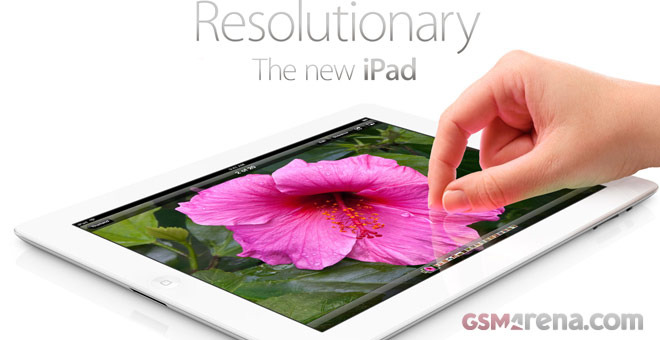
As promised Apple unleashed the new iPad today into 25 more countries around the world. The first wave began on March 16 with Australia, Canada, France, Germany, Hong Kong, Japan, Puerto Rico, Singapore, Switzerland, UK, United States and the US Virgin Island.
Today the iPad officially makes a debut in Austria, Belgium, Bulgaria, Czech Republic, Denmark, Finland, Greece, Hungary, Iceland, Ireland, Italy, Liechtenstein, Luxembourg, Macau, Mexico, The Netherlands, New Zealand, Norway, Poland, Portugal, Romania, Slovakia, Slovenia, Spain and Sweden.
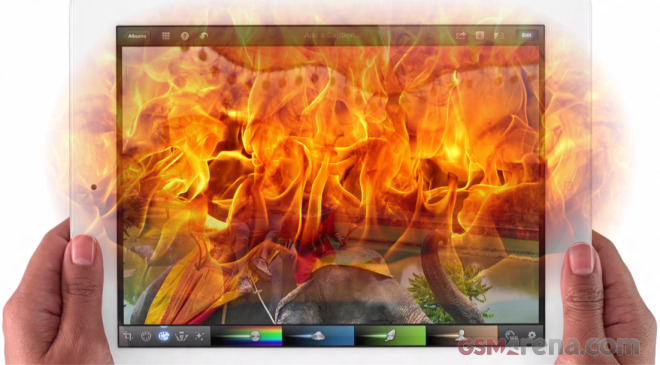
Even more countries are expected to join this list in the next couple of months. Meanwhile our review is already live – you can check how cool is the new Retina display and the 5MP camera, as well as how hot could the iPad becomes because of the new quad-core GPU.
In case you are going to buy the 4G version of the new iPad, we strongly suggest you educate yourself about the supported carriers, bands and hotspots. It’s a bit tricky there.
We are still several months away from the iPhone 5 launch, but we are still getting the occasional rumor about the next Apple smartphone. We just got a particularly juicy one, courtesy ofReuters.
The international news agency quoted an unnamed industry source, who revealed in front of the South Korean Maeil Business newspaper that the next iPhone will be packing a huge 4.6" display. What's even more surprising, Apple will reportedly be unveiling it in Q2, merely 9 months after the 4S was announced.
Unfortunately, exciting as this rumor might all be, we seriously doubt its credibility. You see, switching from a 3.5" to a 4.6" display is as drastic a change as you can imagine and such drastic changes risk alienating some customers. And when you have a user base as large and loyal as the one Apple has, that's the last thing you would want to do.
Also, the Holiday quarter release worked out quite well for the iPhone 4S, which scored record sales, despite not getting as great reception from the media as its predecessor. We don't see how Apple would want to cut its product life short by unveiling its successor in Q2.
So while we'd love to see an iPhone with a larger screen and as soon as possible, we don't think any of this is happening. And 4.6" might be stretching it anyway, so we are not really sure you should feel bad about it.
Giesecke & Devrient, the German company that invented the SIM card, recently came up with the idea of the nano-SIM. This new, even smaller version of the SIM is only a third of the already tiny micro-SIM and will help device manufacturers save some precious space inside their devices.
Image courtesy Esato
But now there is problem. Hardware manufacturers have proposed their own version of the nano-SIM, which they think should be made the standard. Once chosen, the other manufacturers will then have to license it to use it in their devices.
Two of the designs put forth till now are by Apple and Nokia. Apple's design makes use of a tray to hold the nano-SIM, not unlike the ones it uses on the iPhone and the iPad. Nokia, of course thinks that this is not a good idea and that its version of the nano-SIM has significant technical advantages. Moreover, Motorola and RIM seem to agree with Nokia on this.
But if you think Apple is alone in this battle, then you're wrong because Apple is being backed by most of the European Telecommunications Standards Institute (ETSI). Moreover, Apple is registering six different European subsidiaries as voting bodies, that can provide up to 45 votes each, which should be more than enough to outnumber Nokia's existing 92 votes.
Either way, it's certain that the nano-SIM is coming your way shortly. But then, considering the technical advantages it has, it's actually a good thing. And it will be backward compatible with regular SIM using an adaptor. Just make sure you don't lose it.
A few hours ago we told you that some users are complaining that their new iPad is hotter than the iPad 2. The test shows it is indeed warmer than its predecessor when put on stress with just over 5°C.
Apple quickly issued a statement on the matter. Here it is:
“The new iPad delivers a stunning Retina display, A5X chip, support for 4G LTE plus 10 hours of battery life, all while operating well within our thermal specifications. If customers have any concerns they should contact AppleCare.”
So, everything is fine.
Honestly, what did you expect? The new iPad has four graphic cores and four times the pixel count (along with a new technology, which seems to require more powerful backlighting). Of course this one will be warmer than the previous one. And the difference is 5°C, not 50°C.
Really, why everyone is so surprised? I get that every Apple product is surrounded by at least one drama (most of them righteous) , but this is the phoniest of all I’ve ever heard. Did you by any chance hold a PS Vita? It’s hot, hotter than the PSP or this iPad. But no one is complaining or boiling eggs on it. Dear new iPad users, 33°C won’t hurt you fingers.
I’m just asking people to be reasonable. That’s it.
The new iPad has double the GPU cores count of the iPad 2 model and Apple had to increase the battery to handle the increased power usage. However, the increased power consumption isn’t the only problem that the extra GPU power creates – it also produces more heat and causes the new iPad to run hotter than its predecessor.
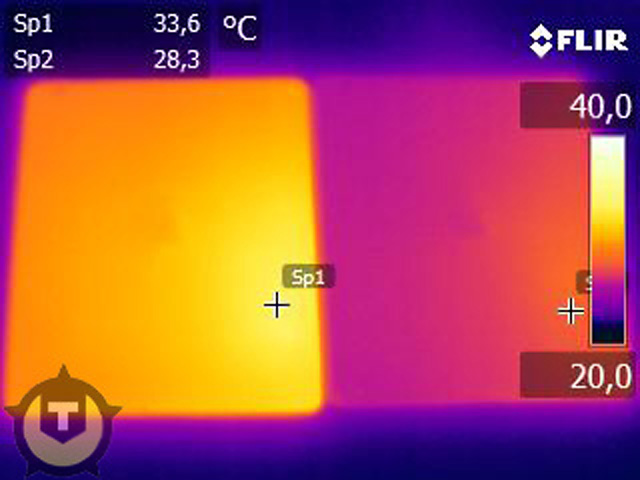
Many users reported that the new iPad feels hotter, but Tweakers.net brought out a thermal camera to get exact numbers.
They ran GLBenchmark – a 3D benchmark – for five minutes and took a measurement of the hottest point on the tablet. The bright spot in the thermal image is easy to see – that’s where the Apple A5X chipset is located.
The hottest point on the new iPad measured 33.6°C (92.5°F), while the iPad 2 kept things cooler at 28.3°C (82.9°F). That’s a difference of just over 5°C and is noticeable but not burning hot.
Also, GLBenchmark is about the worst case scenario for the new iPad – it stresses the powerful but hungry SGX543MP4 GPU. Under normal operation (that is anything other than 3D gaming), the new iPad should run about as cool as its predecessor.
Yesterday, during the conference call, CEO Tim Cook mentioned that the new iPad had a record-breaking opening weekend, but did not provide any actual figures. Well, that information has arrived, as usual, with its own press release. Apple has sold over 3 million new iPads since launch.
When I say ‘launch’ I mean March 16, which is when the device officially went on sale. So basically Apple sold a million new iPad every day since then. And as AppleInsider explains, this number does not include the pre-orders, which were made before the device went on sale.
This makes the number even more staggering. To put it into context, the iPad 2 was estimated to have sold around 1 million units on its opening weekend, which in itself is quite impressive. And here’s some more context: as Phone Scoop’s Eric Zeman pointed out, the sales of the new iPad over three days outnumber the sales of the BlackBerry PlayBook and the Motorola Xoom, combined, over a period of year. And in total, this figure is 1/5th of the total sales of the iPad in the fiscal 2012 quarter. You can imagine how big that figure is going to be in the coming quarters. And let’s not forget, the iPad 2 is still on sale, at a lower price, so it must have sold quite a bit, too.
It seems there is trouble in paradise for owners of the new iPad who wanted to use it with the Smart Cover that they bought for their iPad 2. The problem is that with some users the Smart Cover does not work well with the new iPad, i.e., the display does not switch on and off as it should. This is not only a problem with Apple’s Smart Cover but also with some of the third party ones.
So what could be the reason for this? The answer lies in the polarity of the magnets, as Mark Booth has explained fantastically on his blog.
It’s like this. The iPad 2 uses magnetic sensors around the right side of the display that get triggered with the magnets inside the Smart Cover. Now these sensors aren’t polarity specific, which means they could be triggered by the North or the South side of a magnet. Because of this, the original smart covers for the iPad 2 did not contain magnets aligned in a specific manner because it did not matter.
But by not being polarity specific led to a problem. When the Smart Cover was folded behind the iPad 2, the sensor would sometimes get triggered and the display would shut down. So to take care of this situation, Apple used polarity specific magnets in the new iPad, so they would only get triggered by one side of the magnet within the Smart Cover and so when the other side was near the iPad when the cover was flipped around, the sensors in the iPad would not get triggered.
But by fixing one problem, Apple ran into another. As mentioned earlier, Smart Cover manufacturers, including Apple, did not align the magnets in their older covers in a particular way because it simply did not matter with the iPad 2. But with the new iPad, it has to be in one particular way to trigger the sensor, or else it won’t work. The magnets in these covers were apparently installed at random, so only those which have the right side facing the iPad now work with the new iPad whereas the other ones don’t.
Now it seems Apple realized this problem some time last year and started shipping their new Smart Covers with properly aligned magnets in anticipation of the new iPad. These Smart Covers also have a different model number and work perfectly with both the new iPad as well as the iPad 2. Apple is even reportedly replacing your Smart Cover for free with a new one that works with the new iPad. However, if you are one of the unlucky ones who got a third party smart cover, then you have no choice but to get a new one. Unless, of course, you are ready to strip out the magnet and reverse it, in which case it will work perfectly.
Lots of people are using the iPads just for web browsing so naturally the browser benchmarks matter a lot. We’ve put all the three iPads and the Transformer Prime through SunSpider and Browser Benchmark and the results are now out.
Long story short – the new iPad seems to offer the same browsing performance as the iPad 2.
Shocker? Don’t think so. Both the new iPad and the iPad 2 use same CPUs – the major player responsible for most of those scores. Surely the bigger screen offers a lot more viewing estate, but this is where the new GPU kicks in, so no game changer in the scores here either.
The new iPad 3 scores equal if not marginally lower results than the iPad 2 on both test. See for yourselves.
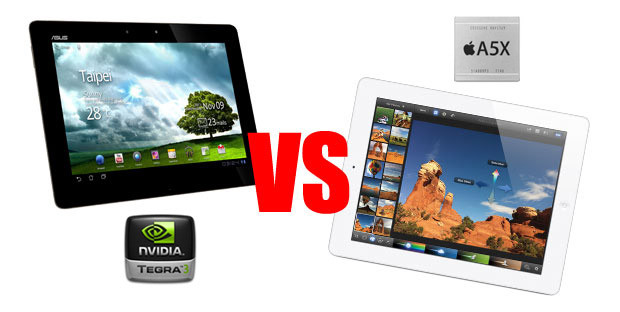
The first direct comparisons of the Tegra 3 found on the ASUS Transformer Prime and the Apple A5X chip found in the new iPad have surfaced.
And what better way to test out these robust tablets than with a gaming comparison?
GLBenchmark – 3D graphics test
Before we get to the nitty gritty, lets look at some head-to-head performance in one of the few OpenGL benchmarking platforms available to both Android and iOS, GLBenchmark. It measures different graphics and computation abilities on devices running the OpenGL standard for mobile devices, OpenGL ES 2.x.
In terms of raw fps performance, the two tablets did not vary by much, with the new iPad processing 6718 frames at 60fps, and the Transformer Prime processing 5939 frames at 53fps.
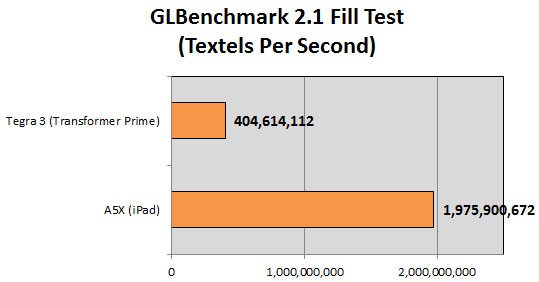
The geometric and fill tests, however, was where the iPad handily outclassed its competitor. The low-level shader geometric test saw 7.5 million frames at 57fps for the new iPad, compared to the 3.5 million at 27 fps from the Transformer. In the program’s fill test, which measures texturing speed, the iPad was able to process almost 2 billion textels per second, as opposed to a tad over 400 million textels from the Transformer.
Geekbench – Processor test
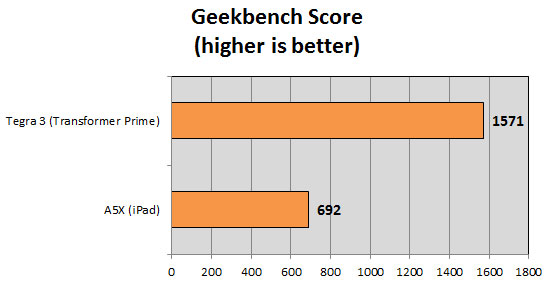
The Tegra 3 gained back some of its lost ground in the Geekbench processor and memory benchmarking tool. The Transformer Prime dominated the new iPad with an overall score of 1571 to 692.
Game comparison
Finally, when taking a look at the cross-platform games available for both devices, we can see some areas where Apple’s new tablet really shines, and others where it needs to catch up.
When comparing Shadowgun, you can see some very crisp details thanks to the higher resolution display found on the new iPad, as well as the better color saturation. However, certain effects are not present – the most prevalent being the absence of the billowing red flags on the iPad version.
Shadowgun on the Transformer Prime (left) and the new iPad (right)
We see the same trends across other games as well – sharper detail and richer colors on the iPad; additional eye candy and effects on the Transformer. The latter is most likely due to the fact that developers have had little time to work with the new A5X chipset, and could not include all of the OpenGL effects found on the Tegra 3 version.
Ultimately, we expect the differences we saw to decrease in the future, first with the implementation of better OpenGL effects on later iterations of iOS games, and second, with higher quality displays on newer tablet editions, such as the upcoming 1920 x 1200 resolution Transformer Prime TF700T, or the Acer Iconia A700.